Introduction
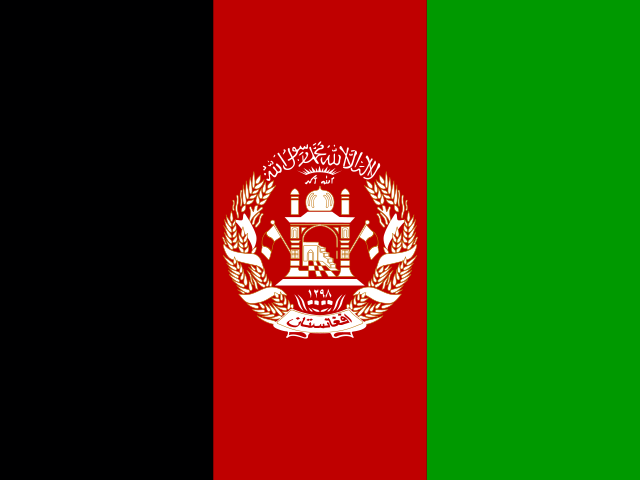
The national flag of Afghanistan is a vertical tricolor of black, red, and green, a color combination unique among national flags. In the center of the red stripe is the national emblem, which is white and features a mosque with a mihrab and minbar, flags, sheaves of wheat, and the Shahada (Islamic creed) inscribed at the top. The emblem is a complex and detailed symbol that is central to the flag's identity and distinguishes it from simpler tricolor designs.
The flag's current form was adopted by the Islamic Republic of Afghanistan in 2004, following the fall of the Taliban's first regime. Its design is deeply rooted in the country's 20th-century history, with the tricolor pattern and central emblem having been used, with variations, for decades. The flag's proportions and the specific rendering of the emblem are officially defined, though its use and recognition have been subject to the nation's turbulent political changes.
As a symbol, the flag represents the Afghan nation and its Islamic faith, with the emblem's elements intended to reflect cultural and agricultural heritage. The precise layout, including the size and placement of the emblem, is codified, making it one of the more intricate national flags in widespread use today.
Meaning & Symbolism
The colors of the tricolor carry historical significance: black symbolizes the dark past of foreign occupation, red represents the blood shed for independence, and green stands for hope and a prosperous Islamic future. This color symbolism dates back to the early 20th century and has been a consistent feature through many of Afghanistan's flag changes.
The central white emblem is rich with symbolic meaning. The mosque with a mihrab represents the nation's Islamic faith. The sheaves of wheat surrounding the mosque symbolize agriculture and fertility. The inscription at the top is the Shahada ("There is no god but Allah; Muhammad is the messenger of Allah"), affirming the foundation of the state religion. The year 1298 in the Hijri calendar (1919 in the Gregorian calendar) at the bottom marks Afghanistan's independence from British influence.
History of the Afghanistan Flag
The modern tricolor pattern was first introduced in 1928 under King Amanullah Khan, replacing earlier solid black flags. The central emblem has undergone numerous modifications reflecting different political regimes, including a communist star and scroll, and the word "Allah" during the Mujahideen and Taliban periods. The Taliban used a plain white flag bearing the Shahada from 1996-2001 and again from 2021 onward.
The current emblem design was reinstated with the establishment of the Islamic Republic of Afghanistan in 2004. This flag was used by the internationally recognized government until the Taliban's return to power in August 2021, after which the Taliban's white flag became the de facto national flag. The 2004 flag remains a symbol for the Afghan diaspora and opposition groups.
Curiosities
- Afghanistan's flag holds the world record for the most changes to its national flag in the 20th century, with at least 20 distinct major designs.
- The flag's emblem includes the numeral 1298, which is the solar Hijri year corresponding to 1919 AD, the year of independence from the British Empire.
- The color combination of black, red, and green in vertical stripes is unique to Afghanistan; no other sovereign state uses this exact tricolor.
Download Flag
Download the flag of Afghanistan in high-quality SVG vector format or PNG raster images. SVG files can be scaled to any size without losing quality.
Construction Sheet
The flag has a 2:3 ratio of width to length. The three vertical stripes of black, red, and green are of equal width. The national emblem in white is centered on the red stripe. Official specifications state the emblem's height is two-thirds the height of the red stripe, with precise details for the complex drawing of the mosque, wheat, and inscriptions.
Flags Similar to Afghanistan Flag
Common Misidentifications
Due to its complex central emblem, it is not commonly misidentified, but the tricolor pattern from a distance can be confused with other vertical tricolors.