
Introduction
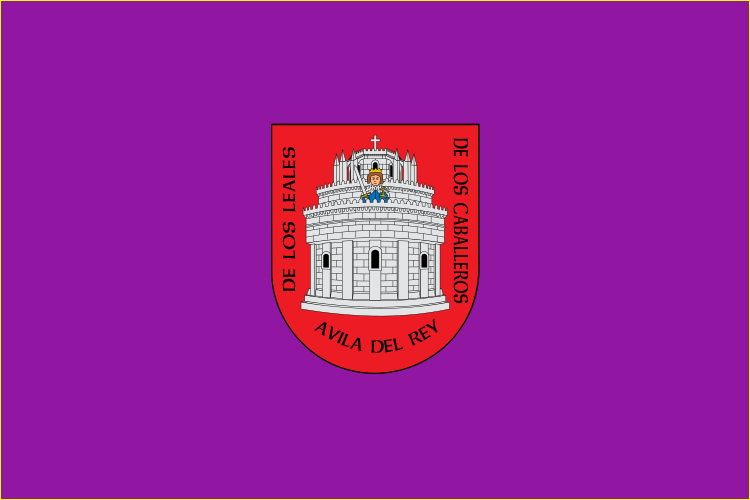
The flag of the Spanish province of Ávila is a distinctive purple banner featuring the provincial coat of arms centered upon it. This design is a direct representation of the province's identity, with the heraldic shield serving as the flag's sole and central graphic element. The choice of a solid purple field is relatively unique among Spanish provincial flags, making it immediately recognizable.
The flag's composition is straightforward, prioritizing clarity and heraldic tradition over complex symbolism in its background. The shield is displayed in its full, proper colors, contrasting sharply against the monochromatic purple. This design ensures the flag is easily identifiable from a distance, fulfilling its primary function as a symbol of territorial authority and civic pride.
Official specifications dictate that the flag's proportions are a standard 2:3 ratio, common for many Spanish regional and civic flags. The entire design is governed by the principles of vexillological simplicity, where the shield is the undeniable focal point without additional charges, fimbriations, or patterns on the field.
Meaning & Symbolism
The meaning of the flag is derived entirely from its central element, the coat of arms of the Province of Ávila. The purple field of the flag itself is often associated with the historical region of Castile, to which Ávila belongs, representing nobility, power, and the legacy of the Castilian monarchy.
The shield is quartered, displaying key symbols of the province's heritage. It features the lion of León and the castle of Castile, acknowledging the province's historical ties to the ancient Kingdom of León and the Crown of Castile. These are classic heraldic symbols representing strength and fortification, respectively. The shield is often shown surmounted by a royal crown, symbolizing the province's status within the Spanish kingdom.
History of the Ávila Flag
The flag's adoption is closely tied to the official approval and standardization of the provincial coat of arms. The current design was formally established and regulated in the late 20th century, following the reorganization of the Spanish state after the end of the Francoist period. The purple field with the centered shield became the official standard for representing the provincial government and its institutions.
Its history is not marked by a single dramatic event but by a process of administrative formalization. The flag serves as a modern symbol of provincial unity and identity, drawing upon centuries-old heraldic traditions that date back to the medieval history of Ávila and the Kingdom of Castile and León.
Curiosities
- The solid purple background is unusual, as purple is a less common color in vexillology compared to red, blue, white, or green.
- The flag is a direct example of an 'armorial banner', where the design of the flag is essentially the field of the coat of arms (purple) with the full shield placed upon it.
- Unlike many Spanish regional flags that incorporate stripes or crosses, the flag of Ávila relies solely on color and a single, complex emblem for its identity.
Download Flag
Download the flag of Ávila in high-quality SVG vector format or PNG raster images. SVG files can be scaled to any size without losing quality.
Construction Sheet
The flag follows a standard 2:3 proportion. The purple field covers the entire flag. The provincial coat of arms is placed at the exact center of the flag. Official regulations specify the shield's height should be two-thirds the hoist width, ensuring it is prominently visible and properly scaled to the flag's dimensions.
Flags Similar to Ávila Flag
Common Misidentifications
Rarely misidentified due to its unique purple color and specific coat of arms, but may be generically recognized as a Spanish provincial flag.