
Introduction
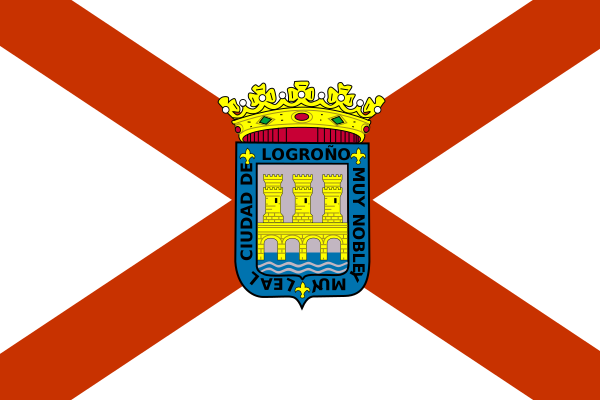
The flag of Logroño, the capital city of Spain's La Rioja region, is a distinctive heraldic banner featuring the city's coat of arms on a crimson red field. This design follows the traditional Spanish practice for municipal flags, where the central coat of arms serves as the primary visual identifier. The flag's layout is simple yet bold, ensuring high visibility and immediate recognition.
The central shield is quartered, displaying a castle, lion, and other heraldic charges that directly reference the city's historical affiliations and geography. The use of a solid crimson background is a notable feature, providing a stark and regal contrast to the multicolored emblem. This color choice is deeply rooted in Iberian heraldic tradition, often associated with royalty, conquest, and community.
As the official symbol of the municipal government, the flag is flown on public buildings and during local festivals, embodying the civic pride of Logroño's inhabitants. Its design is a direct translation of medieval heraldry into a modern vexillological format, maintaining a tangible link to the city's long history.
Meaning & Symbolism
The symbolism of the flag is entirely derived from its central coat of arms. The shield is divided into four quarters, each representing a key historical or geographical aspect of the city. The castle typically symbolizes a fortified town or a royal foundation, reflecting Logroño's strategic importance on the banks of the Ebro River.
Other common elements include the lion, a symbol of the Kingdom of León, which historically held sway over the region, and the fleur-de-lis, often representing the Virgin Mary, to whom the city's cathedral is dedicated. The crimson red field of the flag is a traditional color in Spanish municipal vexillology, denoting the banner under which the city's militia would have historically mustered.
History of the Logroño Flag
The flag's design is based on the city's coat of arms, which has medieval origins, though the exact date of the arms' original grant is not precisely documented in common sources. The current form of the flag, as a banner of arms, was formally adopted for modern municipal use in the latter half of the 20th century, following the standardization of Spanish local symbols after the transition to democracy.
Its use is governed by the city's ordinances and is consistent with the guidelines for Spanish municipal flags, which prioritize the display of the approved heraldic achievement. The flag represents the continuity of Logroño's identity from its founding to its present status as a regional capital.
Curiosities
- The flag is a classic example of a 'banner of arms', where the design of the flag is directly taken from the heraldic shield, a common practice for cities and regions with a strong medieval history.
- Unlike many Spanish regional flags, it does not incorporate the national colors (red and yellow), instead using a solid crimson field that makes it stand out.
- The coat of arms on the flag is also depicted on the 'Puente de Piedra' (Stone Bridge), one of the city's most iconic landmarks, creating a direct link between the symbol and the urban landscape.
Download Flag
Download the flag of Logroño in high-quality SVG vector format or PNG raster images. SVG files can be scaled to any size without losing quality.
Construction Sheet
The flag follows a standard 2:3 proportion. The design consists of a solid crimson red field. The city's coat of arms is placed in the center, its height typically measuring half the hoist width to ensure clear visibility. The arms are usually rendered in full heraldic color, including shades of blue, gold, white, and red, detailed with black outlines.
Flags Similar to Logroño Flag

Common Misidentifications
Rarely misidentified due to its unique central coat of arms, though from a distance the solid red field could be mistaken for other simple red flags.