
Introduction
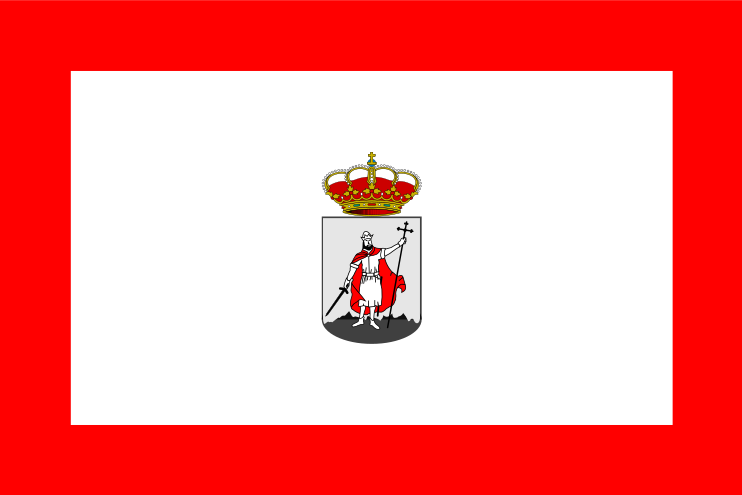
The flag of Gijón, the largest city in the Principality of Asturias, Spain, is a distinctive and vertically divided bicolor. It features a blue field on the hoist side and a white field on the fly side. At the center of the flag, prominently displayed, is the city's official coat of arms, which is a key identifying element. The design is simple yet heraldically significant, clearly representing the municipal authority of Gijón.
The flag's proportions are typically 2:3, a common ratio for Spanish municipal flags. The central placement of the coat of arms ensures high visibility and immediate recognition. The use of blue and white is not only aesthetically pleasing but also carries historical and symbolic weight for the city. This combination creates a clean and official appearance suitable for civic use.
Unlike many Spanish municipal flags that may use more complex divisions or symbols, Gijón's flag relies on the powerful contrast between its two colors and the detailed heraldic charge. The flag is flown at government buildings, during local festivals, and at official ceremonies. Its design effectively balances simplicity with the necessary heraldic complexity required for an official municipal standard.
Meaning & Symbolism
The blue and white colors are deeply tied to the maritime history and identity of Gijón. Blue represents the Cantabrian Sea, upon which the city's economy and culture have been built for centuries. White symbolizes peace, purity, and the bright future of the city. Together, these colors reflect Gijón's status as a major port and its connection to the ocean.
The central coat of arms is the primary symbol, containing multiple historical references. It features the Cross of Victory (Cruz de la Victoria), a pre-heraldic emblem of the Kingdom of Asturias, acknowledging the region's history. The arms also include a depiction of Don Pelayo, the first king of Asturias, and the Roman walls of Gijón, symbolizing the city's ancient origins. A golden crown tops the shield, denoting its status as a city granted by royal charter.
History of the Gijón Flag
The current flag design, featuring the blue and white bicolor with the city's coat of arms, was officially adopted in the late 20th century, following the standardization of municipal symbols in post-Franco Spain. The coat of arms itself has a much longer history, with its basic elements being used by the city council for centuries. The inclusion of Asturian and local historical symbols solidifies its representative role.
The design was formalized to provide a consistent and recognizable symbol for the city government. The choice of colors and the central placement of the traditional arms ensured continuity with the city's past while creating a modern, official banner. The flag's adoption aligns with a broader movement in Spain to codify and register municipal heraldry and vexillology with the relevant authorities.
Curiosities
- The blue and white colors are the same as those used on the flag of the neighboring municipality of Carreño, reflecting a shared historical and geographical connection within central Asturias.
- Unlike the flag of the Principality of Asturias, which is light blue with the yellow Cross of Victory, Gijón's flag uses a darker blue and incorporates its full coat of arms.
- The flag is often seen alongside the Asturian and Spanish flags during the annual Semana Grande (Big Week) festival, the city's most important cultural event.
Download Flag
Download the flag of Gijón in high-quality SVG vector format or PNG raster images. SVG files can be scaled to any size without losing quality.
Construction Sheet
The flag follows a standard 2:3 proportion. It is divided vertically into two equal halves: the hoist half is blue and the fly half is white. The city's coat of arms is centered on the flag, with its height typically being two-thirds the hoist height. The precise shades of blue are defined by the municipal government for official reproduction, ensuring consistency across all uses.
Flags Similar to Gijón Flag
Common Misidentifications
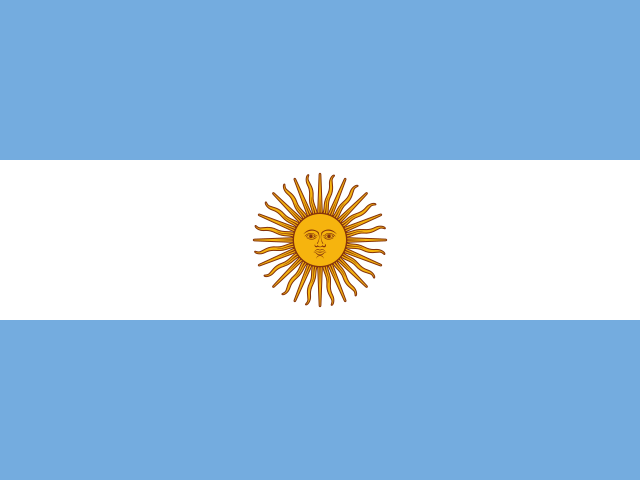
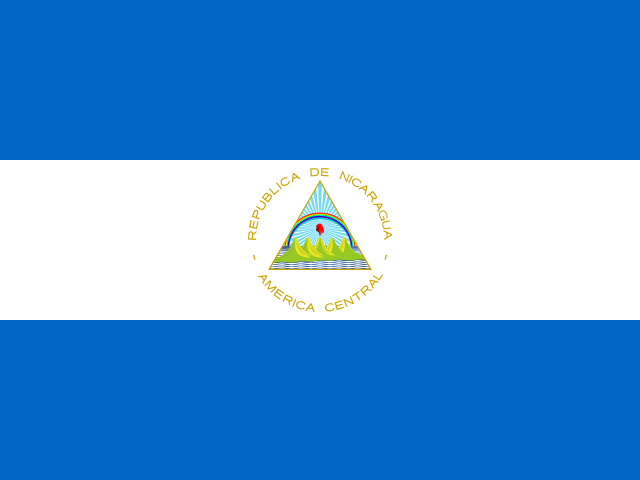
Rarely misidentified due to the distinctive coat of arms, but from a distance, the blue/white bicolor scheme could be loosely associated with other flags using those colors.